
Self-Editing Your Manuscript
The Editing Pyramid

The Editing Pyramid
The first draft… It is DONE!
Now, you just have 30,000 more steps to take before publishing. Cool. Cool. Cool. But which step do you take first and why?
The short answer is: EDIT.
The longer answer is: well, it’ll take the entire post to explain. So, let’s get started.
Why Edit?
Finishing the first draft of your manuscript takes a lot of hard work and a big time commitment. You’ve gotten your ideas onto the pages, and your characters have come to life, but you made some changes to a character’s backstory part-way through the draft, you’re noticing a lot of typos, and you aren’t exactly sure the beginning is as catchy as you’d like it to be. This means there’s some work to do before readers can understand it.
It can be tempting to jump in and start changing everything all at once, but it can be overwhelming when there are so many things to review, revise, and update. That’s why—as I say about many things in life—let’s break it down into little chunks.
How to Self-Edit
I usually suggest a three-step process for each round of editing.
Go as long as you can without looking at your manuscript before starting a round of edits (I suggest at least a week)
Read through your manuscript, make in-line comments, and write notes on paper or in a separate document.
Make revisions.
Repeat this process for each round of editing.
The Editing Pyramid
The way I, and many others, suggest you tackle self-editing is to start very broad and work your way to the tiny details. I like to call this the Editing Pyramid.
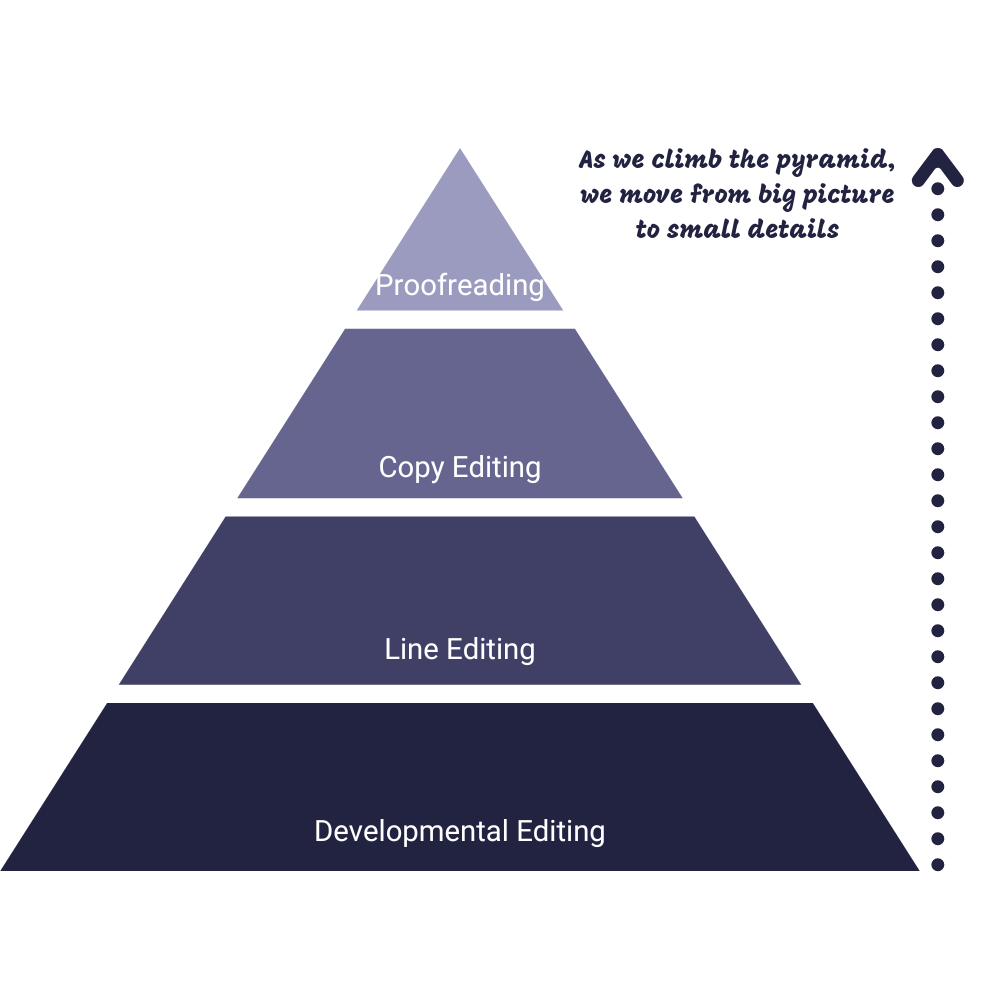
Moving from the bottom to the top, we see our four main editing types: developmental editing, line editing, copy editing, and proofreading. I suggest that each writer do at least one round of each of these editing types on their manuscript—but it never hurts to do more if you have the time and energy to do so.
But what do we do in each of these parts of the pyramid, and how are they different from each other?
I’m glad you asked.
Edit Round 1: The Developmental Edit
Plot. Structure. Characters. Pacing. Settings. Conflict. Theme.
These topics should be the main focus for your first round of edits. But these topics are very broad. I think framing these big-picture edits into questions makes evaluating, identifying issues, and finding solutions easier. The types of questions you can ask are varied, but here are a few of the ones I think are most impactful:
Plot & Structure
Does the plot flow and make sense?
Are the characters’ actions driving the story, or are the characters just along for the ride? (Hint: Most of the time, you want the characters’ actions driving the story.)
Does your story follow a structure (e.g., 3-Act, Save the Cat, Hero’s Journey, etc)? (Hint: There are dozens of common structures, and sticking to one is not 100% necessary. But if you’re struggling with your story’s plot, it could help to try to work with a specific structure.)
Are all your plot threads resolved at the end, including your main story arc, b-plots, c-plots, etc.? And if they aren’t, is that on purpose? Are some things supposed to be left up for interpretation? Is it one book in a longer series that will resolve these plot points in a later book?
Are the major plot point conventions of your genre satisfied? (Hint: Each genre has its own set of conventions or reader-expected scenes, characters, etc.)
Characters
Do your characters have flaws? (Hint: They should.)
Are they competent in at least one thing?
Do they act in believable ways, especially when you consider their backstory, personality, and motivations?
Do they change in some way by the end of the manuscript? (Hint: Again, they should.)
Do all of the secondary characters serve a purpose in the story?
Pacing
How are your paragraph and chapter lengths? (Study popular books in your genre, and ideally make both varied throughout your manuscript. Longer paragraphs and chapters give the reader a sense of slower pacing or calm, while shorter paragraphs and chapters give the reader a sense of faster pacing or urgency.)
Do you spend the right amount of time on scene setting and world building? (This is very genre-dependent, but my main rule of thumb is, don’t tell the reader anything they don’t absolutely need to know, and definitely don’t tell them any information a long time before they need it!)
Is there something at the end of each scene and each chapter that is going to make the reader want to keep reading?
Settings
Are you using all five senses to describe the setting when you can?
Are you over-describing? (Make sure the details you’re including are important to the story.)
Are the settings for all your scenes important to the story? Why are your characters where they are for each scene, and why are you telling the reader this much detail about this particular setting?
Conflict
Does your main character have an internal conflict?
Does your main character have an external conflict?
Are the stakes of both the internal and external conflicts high enough to keep driving the story?
Theme
What is your theme (e.g., circle of life, good vs evil, fate vs free will, etc.)?
Like I said, there are a million other questions you can ask during a developmental edit. Still, these are the most important, in my opinion, especially if you are newer to editing.
Edit Round 2: The Line Edit
Line editing is definitely the most challenging part of self-editing. Most of the authors I’ve worked with agree—after I explain to them what it is. In the developmental edit, we focused on the manuscript as a whole, as well as on chapters and scenes. A line edit is looking at your manuscript at the paragraph level to:
Check for inconsistencies
Make sure each paragraph flows into the next
Adjust paragraphs so that the sentences flow in a pleasing way
This is the most difficult type of editing to do for yourself because you are used to how you write. You are comfortable with the way your sentences naturally flow, the way paragraphs are broken up, and the wordiness, or lack thereof, of your writing. Most writers find it challenging to take that big step back from their own work and look at the writing (not the plot, characters, etc.) objectively.
As with the developmental edit, I have a list of things that I feel are most important for writers to keep in mind when doing their own line edit:
Point of View (POV): First person, third person limited, third person omniscient, etc. You want to keep the POV consistent throughout. No, this is not saying you need to have only one POV character, but if you start with first person, the entire manuscript should be in first person—barring a few exceptions.
Multiple POV Characters: If you’re switching between multiple POV characters, make sure it happens at points that make sense. For newer authors, I suggest only switching POV characters when a new chapter is started, maybe at scene changes. More experienced authors might want to try switching in the middle of scenes, but be careful because this can turn into head-hopping and confuse readers.
Tense: The manuscript should be in the same tense throughout (unless there is a specific flashback scene or something). This can be present tense, past tense, etc.
Voice: Active voice vs passive voice. I recommend that writers try to use active voice as much as possible. There are exceptions to this, like if a character likes to speak in passive voice, or you might throw in some passive voice sentences because it sounds pretty and breaks up an otherwise blunt paragraph. There are likely other exceptions, but you get the gist.
Repetitive Information: Check that you aren’t telling the reader the same piece of information twice. Readers are generally smart and will remember things you tell them, even if it was a few chapters ago.
Repetitive Words: Certain words can stick out to readers if repeated frequently. This can be especially true if they are repeated close together or if they are words people don't often hear in their everyday life. Try to avoid this and either cut the words or find another way to say it. This can also include words like “just” or “sighed.” If you do CTRL+F for “just,” you might just explode.
Adverbs: Typically, it’s “good” writing technique to not use these words as there are often stronger ways to say the same thing. That being said, for a contemporary piece of writing, it might feel strange not to have some. Writers don’t always have to be super descriptive. We don’t want the reader to get fatigued from too much fluffy text.
Keeping it Short: Again, this is not something I think needs to be followed 100% of the time. If every writer did this all the time, everyone’s stories would sound robotic and the same. BUT being overly descriptive is equally bad (if not worse, for some readers). If you think you’ve written the coolest sentence ever, but half of the words are just unnecessary or repetitive, then it’s not a great sentence and can be shortened.
Edit Round 3: The Copy Edit
Copyediting is about grammar, spelling, word choice, and detail consistency. It is performed on your manuscript while still in the draft phase. Trying to write a list of things to look out for in the copyediting phase would be too long to actually be helpful because it would just turn this post into an English class. But there are a couple of tools and techniques you can use to help yourself.
Grammar and Spelling Tools: Software like Microsoft Word and Google Docs have a built-in grammar and spelling checker. There are also third-party software like Grammarly, Pro Writing Aid, PerfectIt, and others. If you’re using any of these, I do not recommend falling into their trap of using their AI tools to change your writing. Try to stick with just the spelling and grammar suggestions. My other word of caution for all of these, including Microsoft Word, is that they do not necessarily follow a particular editing style guide. Typically, in the US, professional editors will use the Chicago Manual of Style for guidance when editing fiction books—unless a specific publisher uses a different style guide. Other countries and different types of nonfiction may use different style guides. So, if you’re trying to stick to the Chicago Manual of Style, it might not be 100% accurate.
Chicago Manual of Style Subscription: You can purchase an online subscription, the big print book, or both from their website. The website is a great tool for all writers, and I recommend everyone get it if you have the money to spare. If you’re not planning to use the Chicago Manual of Style for any reason, which every style guide you plan to use will likely have a similar subscription or purchasing option.
Read Out Loud & Backward: Reading your manuscript out loud forward and backward can help you catch spelling errors, missed words, weird sentence structures, and even missed commas more easily. I believe this is because your brain has a harder time seeing what it wants to if you have to say it out loud. You can also use text readers, so you can hear another voice read it back to you.
Style Sheets: While I recommend writers start creating a style sheet when they begin their first draft, that doesn’t always happen. But that’s okay. The copyedit is a great time to create one if you haven’t already. Your style sheet should include all information about all your characters and settings, and I mean the gritty details like height, hair color, scars, their childhood dog’s name, etc. The goal is to make sure that if something comes up multiple times within the manuscript, it is the same each time. We don’t want your main character’s hair to accidentally be read in chapter one and black in chapter 16 just because you forgot. Creating this guide or reviewing it as you do the copy edit will force you to consider all these small details.
Edit Round 4: The Proofread
Not to be confused with copyediting, proofreading is performed on the final formatted version of your manuscript. Essentially, it’s the final check before you hit the “publish” button. Proofreading typically only looks at the mechanical aspects of your final file: spelling, grammar, and formatting (print and web-based formatting).
Start Your Editing Journey
Go on. Jump in! Take it one step at a time, and don’t rush the process. As always, if you have any questions, you can start a chat thread on Substack, contact me on social media, or work with me as your editor or author coach! Either way, I want you to feel supported and create the story of your dreams.
Sometimes, doing all the editing yourself just isn’t what you want to do.